 admin
adminIntroduction: The Imperative of Uninterrupted Service
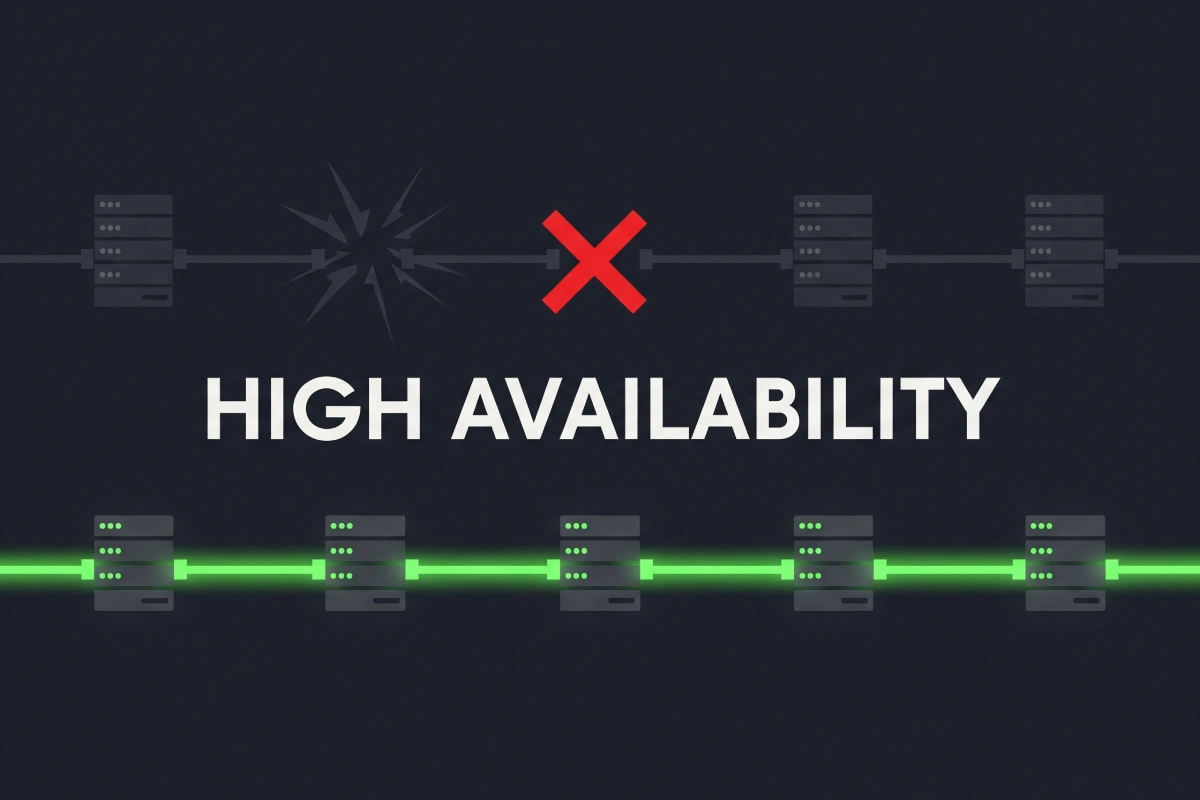
In critical V2Ray deployments—especially those used for business communication, large user bases, or under aggressive censorship—any period of downtime is unacceptable. Downtime leads to lost trust, loss of service access, and a potential window for attackers or censors to gain advantage. High Availability (HA) is the architectural principle of ensuring a service remains operational despite component failures, aiming for continuous uptime often expressed as “five nines” (99.999% availability).
Failover is the specific mechanism within HA that automatically switches traffic from a primary, failed component to a secondary, healthy component. For V2Ray, achieving HA and implementing robust failover involves protecting three core components: the Server IP, the V2Ray Application, and the Client Connection. This process moves the infrastructure beyond simple redundancy (having two servers) to true resilience (having servers that automatically swap roles).
Section 1: The Three Levels of High Availability
Achieving HA for a V2Ray service requires protection at every layer of the network stack, ensuring no single point of failure (SPOF) can take down the entire tunnel.
1. Level 1: Network HA (IP/Entry Point)
The most critical SPOF is the public-facing IP address or domain name. If this entry point is blocked or fails, no client can reach the service, regardless of how many V2Ray servers are running behind it.
- CDN Protection (Article 13): Hiding the server IP behind a CDN like Cloudflare is the primary defense against IP blocking, as the CDN provides a massive, globally distributed pool of IP addresses.
- Floating IP/Anycast: In advanced cloud deployments, a Floating IP (or Anycast IP) can be used. This single public IP address is automatically advertised by two or more geographically separate servers. If the primary server crashes, the network automatically redirects traffic associated with that IP to the backup server, often within seconds.
2. Level 2: Application HA (V2Ray Core)
This level ensures that if the V2Ray service crashes or freezes on the primary server, a backup is ready.
- Docker/systemd Restart: The simplest form of failover is configuring the service manager (
systemdon Linux, or Docker Compose, Article 23) to automatically restart the V2Ray process if it crashes. This provides quick recovery from software bugs. - Active-Passive Redundancy: Two V2Ray servers run simultaneously. Only the primary handles traffic; the secondary monitors the primary’s health. If the primary fails, the secondary takes over the public IP or domain immediately.
3. Level 3: Session HA (Client Connection)
This ensures that the user’s continuous session remains stable, even during a failover event.
- Stateless Protocols (VLESS/REALITY): The use of VLESS (Article 17) is crucial. Since VLESS sessions are stateless, a client can be redirected mid-session to a backup server without any loss of critical session data, as no data was stored on the primary server to begin with.
Section 2: Implementing Automatic Failover with Health Checks
Automatic failover requires two mechanisms: a way to check if the primary server is alive and a mechanism to shift the traffic.
1. The Health Check Mechanism
The backup component must continuously monitor the primary.
- External Pings: The load balancer (or external monitoring tool) sends standard ICMP pings or TCP probes to the primary V2Ray server’s Port 443.
- Internal API Check: A more advanced check uses the V2Ray API (Article 38) to confirm the service is functioning internally. The monitor checks the V2Ray API’s
StatsServicefor a positive response, confirming that the V2Ray core is responsive and capable of handling traffic. If the API fails to respond, the node is marked as unhealthy.
2. DNS-Based Failover (Simple HA)
For basic deployments, the simplest failover is done at the DNS level.
- Multiple A Records: The domain name (
tunnel.com) is registered with two IP addresses: Primary Server IP and Backup Server IP. - Health Check DNS: A service (like Cloudflare’s Load Balancing or a similar DNS provider) continuously checks the health of both IPs.
- Failover: If the Primary IP fails the health check, the DNS service automatically removes the Primary IP from the rotation, ensuring clients only receive the Backup IP address.
- Trade-off: This method is slow, as clients may cache the failed IP address for several minutes (DNS TTL), leading to service interruptions.
Section 3: Advanced Failover Strategies (Load Balancer & Active-Passive)
For enterprise-grade HA, external Load Balancers (LBs) or proxy chaining (Article 30) are used to manage the traffic shift instantly.
1. Load Balancer Failover (Instant HA)
In cloud environments, a single external Load Balancer (LB) receives all traffic.
- Pool Configuration: The LB is configured with a pool containing both the Primary and Secondary V2Ray nodes.
- Real-Time Shift: The LB constantly monitors the health of the nodes. If the primary node fails its Port 443 check, the LB instantly and silently removes it from the pool. All subsequent traffic is rerouted to the secondary node, with the failover often completed in less than 5 seconds.
- Automatic Recovery: When the primary node is brought back online, the LB automatically re-adds it to the pool, often directing a percentage of new traffic to it to test its stability before restoring full service.
2. Multi-Hop Redundancy (Resilience via Chaining)
In a Multi-Hop environment (Client $\rightarrow$ Server A $\rightarrow$ Server B), failover can be implemented at the intermediate layer.
- Redundant Entry Nodes: The client is configured with two entry Outbounds: Server A (Primary) and Server A-Backup.
- Client Failover: If the client fails to connect to the Primary (Server A), the client application automatically attempts to connect to the Backup (Server A-Backup). This pushes the failover responsibility onto the client device, offering extremely fast recovery as it bypasses the network infrastructure’s slower health checks.
Section 4: Testing, Auditing, and Documentation
HA is useless if the failover mechanism is not tested and audited regularly.
1. Chaos Testing
True HA requires Chaos Testing—intentionally shutting down or crashing the primary V2Ray service while monitoring the transition to the backup node. This verifies that the health checks are fast enough and that the secondary node is correctly configured to receive the traffic instantly.
2. Log Auditing
Audit logs (Article 42) must be configured to record failover events. The logs should capture:
- The time the Primary node was marked as unhealthy.
- The time the Secondary node received its first connection after the switch.
- The total connection count drop during the transition. This data is used to calculate the server’s true availability metric.
3. Synchronization of Credentials
The single biggest mistake in HA is configuration drift. The Secondary V2Ray server must be an exact clone of the primary, especially regarding:
- UUIDs/Keys: All authorized UUIDs must exist on both servers.
- TLS Certificates: The secondary must possess valid, unexpired copies of the primary’s TLS certificates.
- Routing Rules: The
config.jsonmust be synchronized so that traffic is routed identically, preventing sudden policy failures on the secondary server. Docker and Volume Mapping (Article 23) are the recommended tools for maintaining this consistency.
Conclusion: Designing for Failure
High Availability is the practice of designing the V2Ray infrastructure to handle and recover from failure seamlessly. By systematically eliminating single points of failure through IP redundancy, applying stateless protocols like VLESS, and implementing automatic failover mechanisms via Load Balancers and continuous health checks, administrators can guarantee near-perfect uptime. Designing for failure is the essential final step in building a resilient, enterprise-grade V2Ray service that remains stable and accessible even under the most demanding conditions.

